
You have 16 points, the dealer shows 10. The first instinct is usually to stand because one more big card could bust you. But if you stand, 16 is quite weak against the dealer's 10. This is the kind of situation that forces many online Blackjack players to choose between a visible risk and a harder-to-spot disadvantage.
To know when to hit in Blackjack, just looking at your total isn't enough. The decision also depends on the dealer's upcard, whether your hand is hard or soft, whether doubling or splitting is available, and the table's rule set. The same 18 points — 10-8 usually means stand, but A-7 may need different handling when the dealer shows 9, 10, or Ace. The same 11 points — doubling is often worth considering against many upcards, but a table that doesn't check for dealer Blackjack can change the choice before a 10 or Ace.
Blackjack has no guaranteed winning move in any single hand. Basic strategy only helps players choose the option with better probability within a specific rule set. That's why the most important thing isn't memorising a phrase like "always hit 16" or "always double 11", but knowing how to read all three data points before pressing the button.
Key Points to Remember
- Always read your total together with the dealer's upcard; don't decide based on a single number.
- Hard and soft hands can have the same total but very different risk when hitting.
- Under common reference rules, hard 17 and above usually stand; 11 is usually a strong zone to consider doubling.
- Aces and 8s are typically the two pairs to split; 5s and 10s typically should not be split. Some exceptions depend on table rules.
- Soft 17, number of decks, Blackjack checks, doubling after split, and Blackjack payout ratios can all change the decision.
- Basic strategy doesn't eliminate the house edge and doesn't guarantee a win; bankroll management still determines whether a session stays under control.
Which Online Blackjack Rules Directly Affect Your Decisions?
The basic goal of Blackjack is to have a higher total than the dealer without exceeding 21. Cards 2 through 10 count at face value, J, Q, and K count as 10, and an Ace can count as 1 or 11 depending on which benefits the hand. Two initial cards consisting of an Ace and a 10-value card make a natural Blackjack, but the payout must be checked against the specific table rules.
After receiving two initial cards, players can face options like hitting, standing, doubling, or splitting. Some tables also offer surrender or insurance. The dealer doesn't choose a strategy like the player but must act according to fixed rules, usually hitting to a certain threshold and then standing. Specifically for soft 17 — a hand with an Ace counted as 11 and a total of 17 — some tables require the dealer to hit, others to stand.
That difference isn't decorative detail. If the dealer hits on soft 17, some doubling decisions or soft-hand handling will differ from a table where the dealer stands on all 17s. Online Blackjack rules can also restrict doubling to totals of 9, 10, or 11 only, disallow doubling after splitting, or deal only one card to each Ace after splitting. Players need to open the table's info section before using any strategy chart.
|
Factor to Check |
Why It Affects Decisions |
|
Whether the dealer hits or stands on soft 17 |
Changes some decisions with soft hands and doubling |
|
Whether Blackjack is checked for |
Affects risk when doubling or splitting against 10 and Ace |
|
Which totals can be doubled |
Not every table allows doubling on any two initial cards |
|
Whether doubling after split is allowed |
Changes the value of splitting small pairs |
|
Rules for splitting Aces |
Can limit the number of splits and cards drawn after splitting |
|
Blackjack payout ratio |
Affects the overall value of the table, though not individual hit/stand decisions |
|
Number of decks |
Can change some cells in the basic strategy chart |
If you haven't read the rules, don't rush to pick a table just because the interface looks nice or the deal is fast. The content on how to choose online card games helps expand the criteria for choosing games by rules, pace, and level of control rather than just by feel.
Reading Hard and Soft Hands Before Deciding to Hit
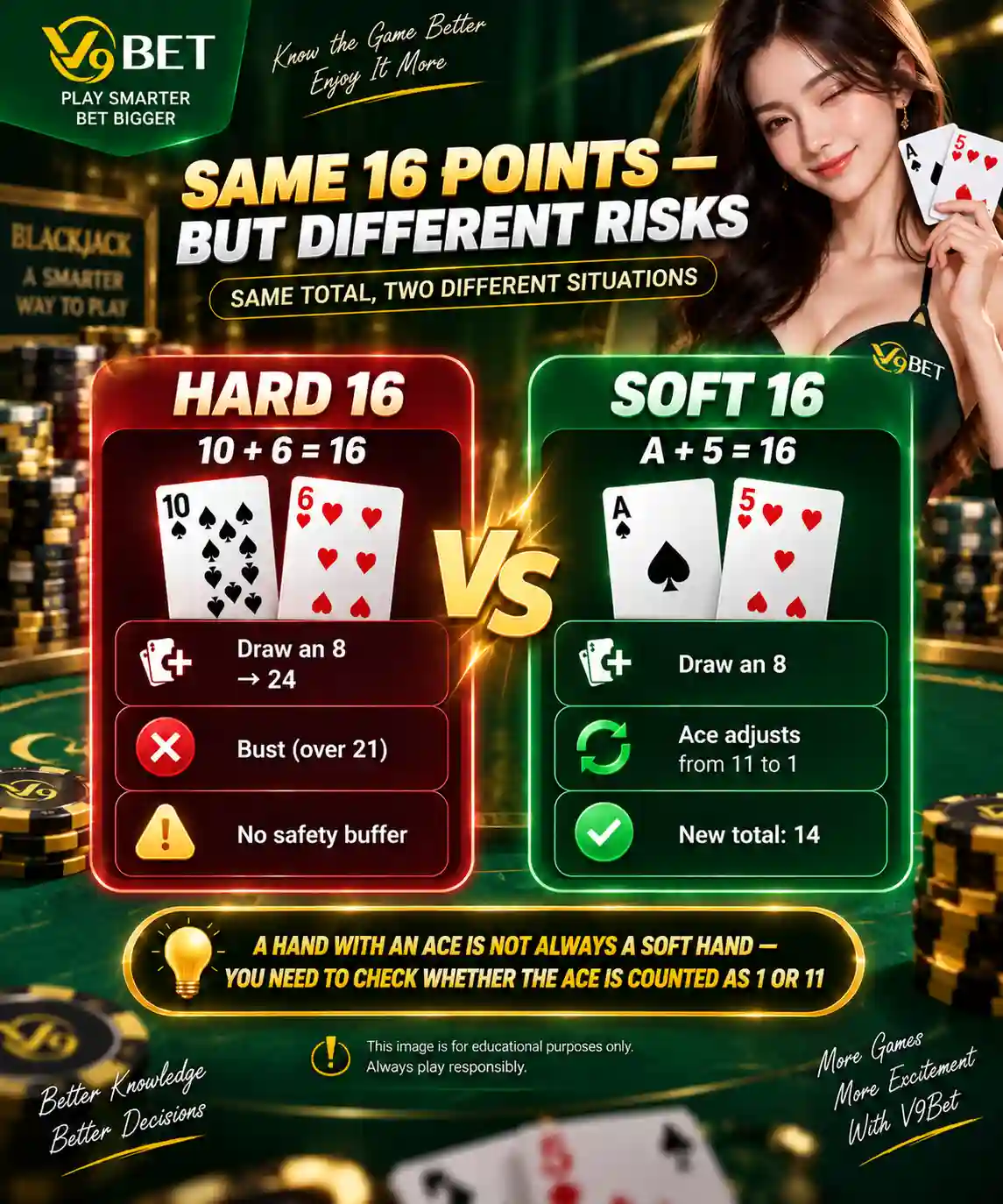
A hard hand is one without an Ace, or with an Ace that must be counted as 1 to keep the total from exceeding 21. A soft hand has an Ace still counted as 11. The difference is in the "buffer": hitting a soft hand usually doesn't bust immediately, because the Ace can drop from 11 to 1.
For example, 10-6 is hard 16. If you draw an 8, the total becomes 24 and you lose immediately. A-5 also shows 16 but is soft 16; when you receive an 8, the Ace becomes 1 and the hand becomes 14 instead of busting. Two hands both showing 16 but they can't share the same reflex.
This is why beginners often stand too early with soft hands. They see 18 and think every 18 is strong enough, while A-7 against a strong dealer upcard may need to hit according to the applicable rules. Conversely, players who only remember "soft hands are safe to hit" tend to overlook opportunities to stand or double when the dealer shows a weak card.
|
Concept |
Example |
How to Understand It |
|
Hard hand |
10-6, 9-7, A-6-10 |
Ace no longer counted as 11, or the hand has no Ace |
|
Soft hand |
A-5, A-7 |
Ace is counted as 11 and can drop to 1 if a big card is drawn |
|
Pair |
8-8, A-A, 5-5 |
Two initial cards of the same rank or value per the table's split rules |
|
Natural Blackjack |
A-10, A-K |
Total 21 from the first two cards; payout per table rules |
Before every decision, read in this order: hard or soft, current total, then the dealer's upcard. This three-second check is more useful than trying to guess the next card based on the last few hands.
When Should You Hit in Blackjack with a Hard Hand?
Under common multi-deck rules, hard hands of 8 or below usually hit because the current total is too low to stand. From 17 and above, standing is usually correct because the risk of busting with another card is significant while the current total is competitive. The hard part is the 12 to 16 zone, where the dealer's upcard largely determines the move.
When the dealer shows 4, 5, or 6, they're at risk of having to draw multiple times to reach their standing threshold. Players with medium hard hands usually don't need to push themselves into bust risk. That's why hard 12 usually stands against 4-6, and hard 13-16 usually stand against 2-6 in the common reference chart.
When the dealer shows 7, 8, 9, 10, or Ace, standing on 12-16 exposes a weak total. Hitting can bust you, but standing often puts you at a disadvantage. That's why hard 16 against 10 is typically advised to hit if the table doesn't offer a suitable surrender option. An uncomfortable move doesn't mean a wrong move.
|
Hard Total |
Dealer Upcard |
Reference Action |
|
8 or below |
Any |
Hit |
|
9 |
3-6 |
Double if allowed; otherwise hit |
|
9 |
2 or 7-Ace |
Hit |
|
10 |
2-9 |
Double if allowed; otherwise hit |
|
10 |
10 or Ace |
Hit |
|
11 |
2-10 |
Usually double if rules allow; otherwise hit |
|
11 |
Ace |
Depends on whether the dealer checks for Blackjack and soft 17 rules |
|
12 |
4-6 |
Stand |
|
12 |
2-3 or 7-Ace |
Hit |
|
13-16 |
2-6 |
Stand |
|
13-16 |
7-Ace |
Hit or surrender in some cases if the table allows |
|
17 and above |
Any |
Stand |
This table is a guide for a common multi-deck Blackjack configuration, not a replacement for the correct strategy chart for the table you're playing. Cells involving 11 against Ace, 15-16 against 10 or Ace are especially prone to changing based on Blackjack check rules and surrender options.
How hard and soft hands differ
When Should You Stand in Blackjack Instead of Hitting?
You should stand when your current total is better kept than the expected value of drawing another card. With hard 17 and above, the decision is usually clear. In the 12-16 zone, standing makes more sense when the dealer shows a weak card, because you can let the dealer bear the obligation to draw and risk busting.
Beginners often stand on hard 15 or 16 against 9 or 10 just because they fear "busting". That fear is understandable, but it only looks at the risk of hitting and ignores the risk of standing with a low total. If the dealer starts with a strong card, 15 or 16 is hard to win with if it can't be improved.
The opposite also happens often: players hit hard 13 against 5 because they think the total isn't high enough. In common configurations, the dealer showing 5 is a situation where you should let them complete their drawing obligation. Hitting here can turn a hand that still had a chance to win through a dealer bust into an immediate loss.
Standing isn't the "safe" decision in every situation; it's a comparison of two sets of probabilities. Sometimes standing still loses. Sometimes hitting correctly still busts. A good move is judged over many hands under the same conditions, not by the single result that just occurred.
Soft Hands: Should You Hit, Stand, or Double?
Soft hands allow more flexible handling because the Ace provides a buffer. With soft 17 and below, hitting is usually the base option if there's no suitable doubling opportunity. Soft 19 and above usually stand, though some rule sets have exceptions for doubling soft 19 against 6. Soft 18, i.e., A-7, is the zone that requires the closest look at the dealer's upcard.
By common reading, A-7 can stand against 2, 7, and 8; consider doubling against the weak group 3-6 if rules allow; hit against 9, 10, or Ace. Some H17 charts handle A-7 against 2 differently from S17 charts. This is the clearest example of how memorising a general line can easily go wrong when switching tables.
Hands A-2 through A-6 usually hit if no suitable doubling condition appears. Doubling opportunities concentrate when the dealer shows a weak card, but the exact range changes with the soft total and table rules. If you don't remember the doubling cell precisely, hitting is the usual fallback; you shouldn't double on your own just because "it's hard to bust".
|
Soft Hand |
Dealer Upcard |
Reference Action |
|
A-2 to A-4 |
Suitable weak group |
May double per the table chart; otherwise hit |
|
A-2 to A-4 |
All other cards |
Hit |
|
A-5, A-6 |
3-6 or 4-6 depending on total |
May double; otherwise hit |
|
A-7 |
3-6 |
Usually consider doubling; otherwise stand |
|
A-7 |
2, 7, 8 |
Usually stand, but check the variant against 2 |
|
A-7 |
9, 10, Ace |
Hit |
|
A-8, A-9 |
Most situations |
Stand; some rules have exceptions for A-8 against 6 |
The point to remember isn't every small cell, but the way of thinking: soft hands can absorb another card better than hard hands, but they still have to be compared against the strength of the dealer's upcard. When a soft total is high enough, continuing to hit just because you can't bust immediately is no longer logical.
When Should You Double Down in Online Blackjack?
Doubling means increasing your original bet and usually receiving only one more card. Because the amount wagered increases while your options narrow, this choice is only worth it when the first two cards create a clear enough advantage against the dealer's upcard. The most common zones are hard 9, 10, and 11, plus some soft hands against weak cards.
Hard 10 usually considers doubling against 2-9 but hits against 10 or Ace. Hard 9 usually doubles against 3-6. Hard 11 has a wider doubling range, but handling against Ace or 10 needs to check whether the dealer has already checked for Blackjack. At tables without a hole card or without protecting the extra amount when the dealer has Blackjack, doubling against strong cards may be less attractive.
With soft hands, doubling isn't because "you can't bust", but because you have a chance to improve while the dealer shows a weak card. A-6 or A-7 against 5-6 are common situations. If the table doesn't allow doubling at that total, players fall back to the alternative action in the chart, usually hitting or standing depending on the hand.
A real-world mistake is doubling after a losing streak to try to win money back quickly. The double button in Blackjack is a strategic decision for the right hand structure, not a recovery tool. If your total doesn't fit, increasing your stake only makes a weak decision more expensive.
|
Situation |
Why Doubling May Apply |
When to Be Cautious |
|
Hard 9 against 3-6 |
Chance to improve while the dealer shows a weak card |
Not every table allows doubling on 9 |
|
Hard 10 against 2-9 |
Many 10-value cards can create a strong total |
Avoid applying it mechanically against 10 or Ace |
|
Hard 11 against 2-10 |
One 10-value card creates 21 |
Check rules when the dealer shows Ace or doesn't check for Blackjack |
|
Low soft hands against 5-6 |
Ace provides a buffer and the dealer has a weak card |
Exact range depends on the soft total and table rules |
|
A-7 against 3-6 |
Can increase the value of soft 18 |
The decision against 2 differs between some rule sets |
Blackjack Pair-Splitting Tips: Which Pairs to Split and Which to Keep?
The two easiest rules to remember are usually split Aces and 8s, but don't split 5s and 10s. Splitting Aces turns a difficult soft 12 into two fresh chances starting with an Ace. Splitting 8s frees you from hard 16, one of the hardest totals to handle. Meanwhile, a pair of 10s is already a very strong 20; splitting usually breaks up a good hand.
A pair of 5s shouldn't be split because the total of 10 is a good value to hit or double. If you split, you turn a favourable hard 10 into two hands starting from 5. With 2, 3, 4, 6, and 7, the decision depends more on the dealer's upcard and whether the table allows doubling after splitting.
|
Initial Pair |
Reference Action |
|
A-A |
Usually split |
|
10-10 |
Stand, don't split |
|
9-9 |
Split against 2-6 and 8-9; stand against 7, 10, Ace |
|
8-8 |
Usually split; check exceptions at tables that don't check for Blackjack |
|
7-7 |
Usually split against 2-7, hit against 8-Ace |
|
6-6 |
Usually split against 2-6 if rules allow, otherwise hit |
|
5-5 |
Treat as hard 10, don't split |
|
4-4 |
Only split in certain situations if doubling after split is allowed |
|
2-2, 3-3 |
Usually split against weak cards when rules allow doubling after split |
The pair-splitting tip only has value when the player still has enough bankroll to place another bet equal to the original. If splitting pushes the total money on the table beyond the session's limit, the problem isn't strategy anymore. Choosing a smaller base bet will help players keep the ability to use the split or double button correctly when the situation arises.
You can also compare how Blackjack and Pok Deng differ to avoid carrying decision habits from one game to another just because both use cards and totals.
Are Insurance and Surrender Better Options Than Hitting?
Insurance is a side bet that appears when the dealer shows an Ace, while surrender allows you to end the hand early and lose part of your bet if the table supports it. These two options can't be grouped with hitting or standing because they address different situations. Insurance puts extra money on the dealer having Blackjack; surrender accepts a smaller loss instead of playing out a very unfavourable hand.
Beginners often buy insurance because the name creates a feeling of protection. In reality, it's a separate bet that needs to be evaluated by probability and the table's payout ratio. Without following a valid card-counting method in an environment that allows it and without knowing the remaining deck composition, basic strategy usually doesn't prioritise insurance.
Surrender can be reasonable for some hard 15 or 16 hands against a strong upcard, but the range depends on whether the dealer hits or stands on soft 17 and when surrender is allowed. If the table doesn't have this button, players return to the hit-or-stand decision per the appropriate chart. Don't assume every online Blackjack table has the same options.
Three Situations Where Players Often Press the Wrong Button in Online Blackjack
The first situation is hard 16 against 10. Players see the bust risk and stand, even though the 10 upcard makes 16 hard to compete with. If the table allows surrender and the rules fit, that may be the preferred option; if not, the reference strategy usually leans toward hitting. Drawing a big card doesn't prove the decision wrong.
The second situation is A-7 against 9. The screen shows 18, creating a feeling it's enough to stand, but this is soft 18. Against the dealer's 9, common charts usually require hitting. The Ace can drop from 11 to 1 if a big card is drawn, so the hand still has room to improve.
The third situation is 8-8 against 6. Standing means playing hard 16, while splitting creates two hands starting from 8 while the dealer shows a weak card. However, the player must place an additional bet for the second hand. If the base bet is already too large to split comfortably, the mistake lies in the bet sizing before the hand.
These situations show that Blackjack experience at V9Bet isn't just about memorising a chart. Players need to keep bets small enough to still have the option to double or split without destroying their bankroll, and they shouldn't judge a move by a single short-term result.
What to Check When Choosing a Blackjack Table at V9Bet?
Before joining a table, open the rules section and check the exact variant name, number of decks, soft 17 rule, Blackjack payout ratio, doubling conditions, split limits, and whether the dealer checks for Blackjack before or not. This article doesn't claim every table at V9Bet uses the same configuration, as the catalogue and rules may differ between providers or change over time.
Next is the betting limit. The minimum bet needs to fit your bankroll, but players must also leave room for doubling or splitting. If you allocate 500,000 VND for the whole session but choose a 100,000 VND bet per hand, one hand with a split and then a double can increase your committed amount very quickly. A starting bet of 25,000 or 50,000 VND in the same example would create more room to manoeuvre, though it doesn't make the result of each hand more predictable.
Table pace also matters. Live tables give limited decision time, while automated versions can run faster and increase the total number of hands without the player realising. The content on how to choose casino games based on experience can help identify a suitable game pace before worrying about the number of tables.
Bankroll Management When Hitting, Standing, Doubling, and Splitting
Basic strategy only manages decision quality, not the amount of money. A player who chooses the right action but bets too large can still lose control after a few unfavourable hands. Because Blackjack has doubling and splitting, the actual amount placed in a round can be several times the base bet.
Suppose the session bankroll is 1,000,000 VND. If the base bet is 50,000 VND, the player still has room for situations requiring additional money. If the base bet is 250,000 VND, one hand with a split and a double could already consume most of the bankroll. The ratio between base bet and bankroll matters more than the feeling of confidence about the hand just received.
Don't increase bets after a loss. A losing streak doesn't make the next hand "due to win", and a winning hand doesn't erase the risk of an oversized double. Setting a loss limit, time limit, and stopping point before the session helps players avoid negotiating with themselves once their mindset has changed.
The article on bankroll management for card games goes deeper into splitting budgets by levels. When applied to Blackjack, it should include the money that could arise from splits and doubles rather than just counting the expected number of hands.
Mistakes That Make the Strategy Chart Useless
The most common mistake is using the right chart for the wrong rule set. A chart for a dealer who stands on soft 17 can differ from a chart for a dealer who hits on soft 17. Charts that allow doubling after splitting also don't fully match tables where this action is banned. Screenshotting a chart online and applying it to every table easily creates a feeling of method while actually lacking the underlying data.
The next mistake is looking at other players' hands or previous results to guess the next card, when the game uses multiple decks and may reshuffle by its own mechanism. Without transparent information about the remaining deck composition, streaks of "lots of big cards just came out" aren't enough to replace basic strategy.
Players also abandon the chart due to emotion. After hitting correctly but busting, they switch to standing on every hard 16. After splitting 8s and losing both hands, they decide never to split 8s again. A choice with better expected value can still lose in a specific hand; strategy doesn't promise short-term results.
Finally, opening too many hands or speeding up. Blackjack requires reading hard hands, soft hands, upcards, and rules. If the pace makes players press buttons by reflex before checking enough data, slowing down or ending the session is a more sensible choice than trying to fix mistakes with bigger bets.
FAQ on When to Hit and Stand in Blackjack
When should I hit in Blackjack?
Under the common multi-deck reference chart, hard 8 or below usually hits; hard 12 hits against 2-3 and 7-Ace; hard 13-16 usually hits against 7-Ace. Soft hands of soft 17 or below usually hit if there's no suitable doubling opportunity. The exact decision still has to follow the table's rules.
Should I always stand on 16?
No. Hard 16 usually stands when the dealer shows 2-6 but hits against 7-Ace if there's no suitable surrender option. Soft 16 needs different handling because the Ace can drop from 11 to 1.
When should I double down in Blackjack?
The common zones are hard 9 against 3-6, hard 10 against 2-9, and hard 11 against many dealer upcards. Soft hands also have some doubling opportunities against 3-6. Check the double limits and the dealer Blackjack check rules.
Which pairs are always recommended to split?
Aces and 8s are the two pairs usually recommended for splitting in basic strategy. However, no-hole-card rules or the way extra bets are handled when the dealer has Blackjack can create exceptions at some tables.
Why shouldn't I split a pair of 10s?
Two 10-value cards create a total of 20, a very strong hand. Splitting breaks up a good total to create two new hands with unknown outcomes. A pair of 5s also usually shouldn't be split because it should be treated as hard 10.
What is a soft hand?
A soft hand has an Ace counted as 11 with a total not exceeding 21. If a big card is drawn, the Ace can drop to 1. That's why soft 18 like A-7 is completely different from hard 18 like 10-8.
Does basic strategy guarantee a win?
No. Basic strategy only chooses the action with better expected value within a specific rule set. The house still has an edge, short-term results still vary, and players can still lose even when playing correctly.
Should I buy insurance when the dealer shows an Ace?
Basic strategy usually doesn't prioritise insurance if the player doesn't have reliable information about the remaining deck composition. Insurance is a side bet, not a free layer of protection for the main bet.
Expert Conclusion
To know when to hit in Blackjack, read all three factors: your hand type, your total, and the dealer's upcard. Hard 17 and above usually stand; hard 12-16 changes with the strength of the upcard; soft hands have a buffer; and doubling and splitting should only be used when the hand structure and table rules create suitable conditions.
More important than memorising a few numbers is knowing which rule set the strategy chart is based on. Soft 17, Blackjack checks, number of decks, and doubling after splitting can all change the move. Before playing online Blackjack at V9Bet, players should open the correct table's info section and cross-check the corresponding chart.
A correct decision can still lose in a specific hand. Don't increase bets to fix the result that just happened, don't double just to recover, and don't choose a bet size that leaves you unable to split when needed. Strategy helps reduce mistakes; limiting your bankroll and knowing when to stop is what keeps the entire session under control.